
Accurate identification of buried networks is essential for the success of any modern construction project. Find out what the advantages of detecting underground utilities using GPR (Ground Penetrating Radar) are and how this non-invasive solution eliminates financial risks while protecting the safety of your site teams.
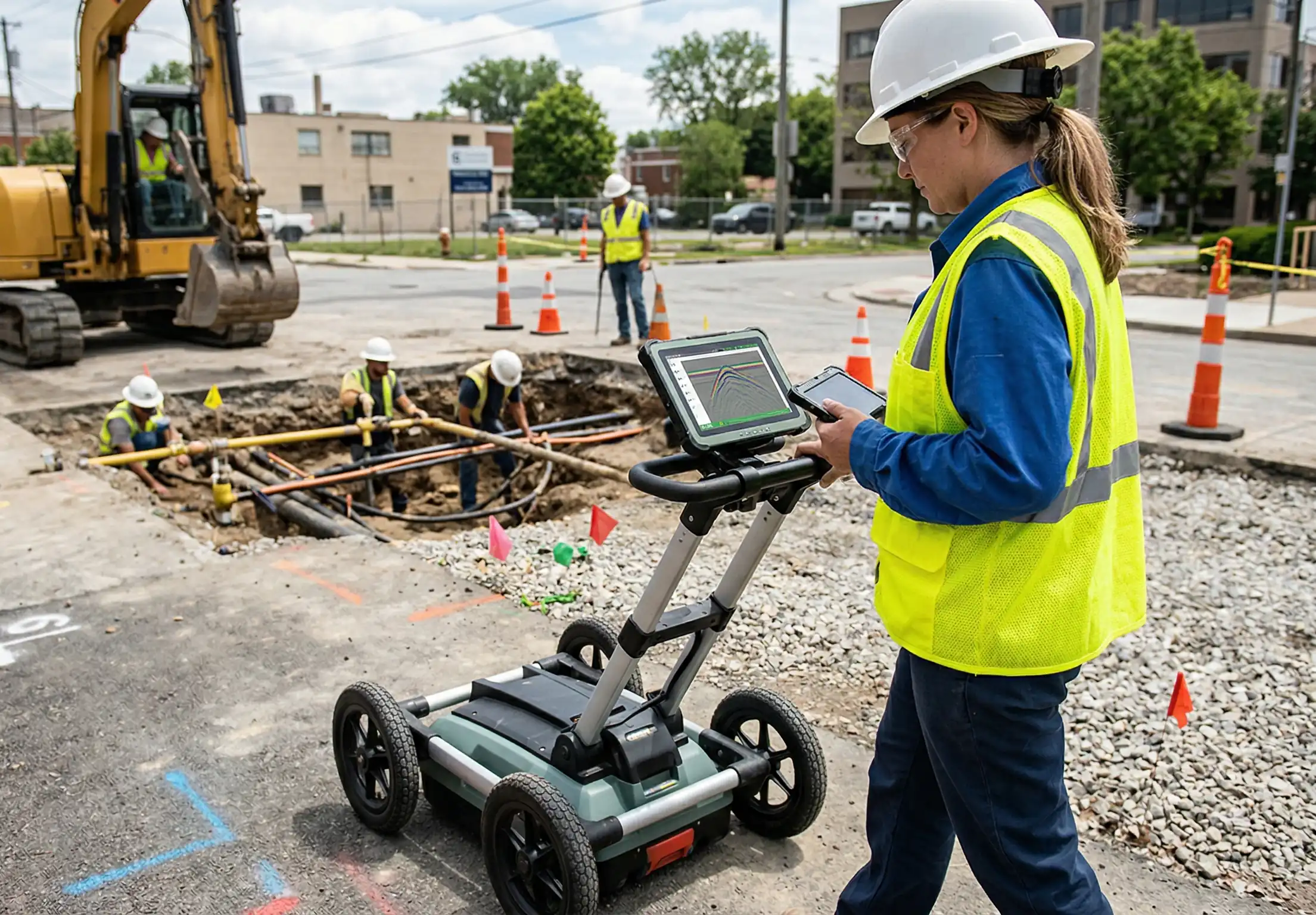
*The equipment in the picture is indicative, it does not belong to IDS
1. The critical importance of mapping buried infrastructure
Before starting any excavation work, knowing the exact route of pipes and cables is mandatory. Relying on old plans or traditional methods carries major risks. By calling on experts in utility detection, companies can avoid unpleasant surprises in the field.
Here are the main benefits of high-precision scanning:
- Increased safety: Prevents the accidental severing of high-voltage electrical cables or gas pipelines.
- Cost efficiency: Eliminates downtime and massive expenses for unforeseen repairs.
- Intact environment: Non-invasive scanning maintains soil integrity without the need for destructive trial digging.
2. How Ground Penetrating Radar (GPR) works
GPR technology works by emitting electromagnetic pulses into the ground and measuring the signals reflected by the various structures encountered. This non-invasive scanning method allows us to generate detailed 3D mapping. GPR accurately identifies not only metal pipes but also plastic or concrete ones—elements that are often invisible to other instruments.
Key Insight
According to the British standard PAS 128, using GPR technology alongside electromagnetic locating (EML) supports achieving the QL B quality level, providing the highest degree of certainty in the surface localization of utilities.
Adaptability of GPR sensors and frequencies
A key factor in GPR's efficiency is its adaptability to various soil types. High-frequency antennas offer excellent resolution for shallow targets (e.g., telecommunication cables). On the other hand, lower-frequency antennas can penetrate to greater depths, making them ideal for identifying water mains or deep sewer pipes.
Conclusion: An essential step for safe projects
Integrating GPR technology into the planning phase of a project is no longer simply a "bonus", but a fundamental necessity for efficiency. The advantages of detecting underground utilities using GPR translate directly into employee safety, budget compliance, and on-time project delivery. Leave the guesswork behind and rely on precise spatial data.